Like other cities around the world, Philadelphia is seeing changes in its weather and climate patterns. According to the Philadelphia Water Department’s Climate-Resilient Planning and Design Guidance engineers, a storm that once had a 1-in-100 chance of happening each year (a “100-year storm”) could have a 1-in-7 chance by the end of the century, assuming greenhouse gas emissions continue at high levels.
This means that heavy rainstorms once considered rare are becoming more common and are bringing more rain in a shorter amount of time.
For instance, the storm that hit parts of West Philadelphia on July 11 shows how quickly extreme rain can overwhelm streets and storm drains.
So what is the Philadelphia Water Department (PWD) doing to prepare for a changing climate?
How is PWD planning for climate change?
PWD studies how climate change may affect Philadelphia’s water systems now and in the future.
Through our Climate Change Adaptation Program (CCAP), PWD looks at how a changing climate could affect rainfall, air temperatures, sea levels and drought, and associated risks to the city’s drinking water, wastewater, and stormwater systems. PWD uses the latest climate science when planning new projects. This helps make sure the work done today can continue to reliably serve Philadelphia for many years to come.
As new science and information become available, PWD updates its long-term plans and projects to ensure resiliency to climate change. The Department also looks at innovative solutions used in other cities to reduce climate-change risk to see if they might work in Philadelphia.
The goal is simple: to prepare today for the climate conditions Philadelphia may face tomorrow.
Why can’t PWD just build bigger pipes?
It’s a question people often ask: If heavier rain is becoming more common, why not just build bigger pipes? The answer is that no city can build a drainage system large enough to prevent flooding during every extreme storm.
During a very heavy storm, rain can fall faster than storm drains can collect it. Even much larger pipes cannot prevent all flooding if water cannot enter the drains quickly enough.
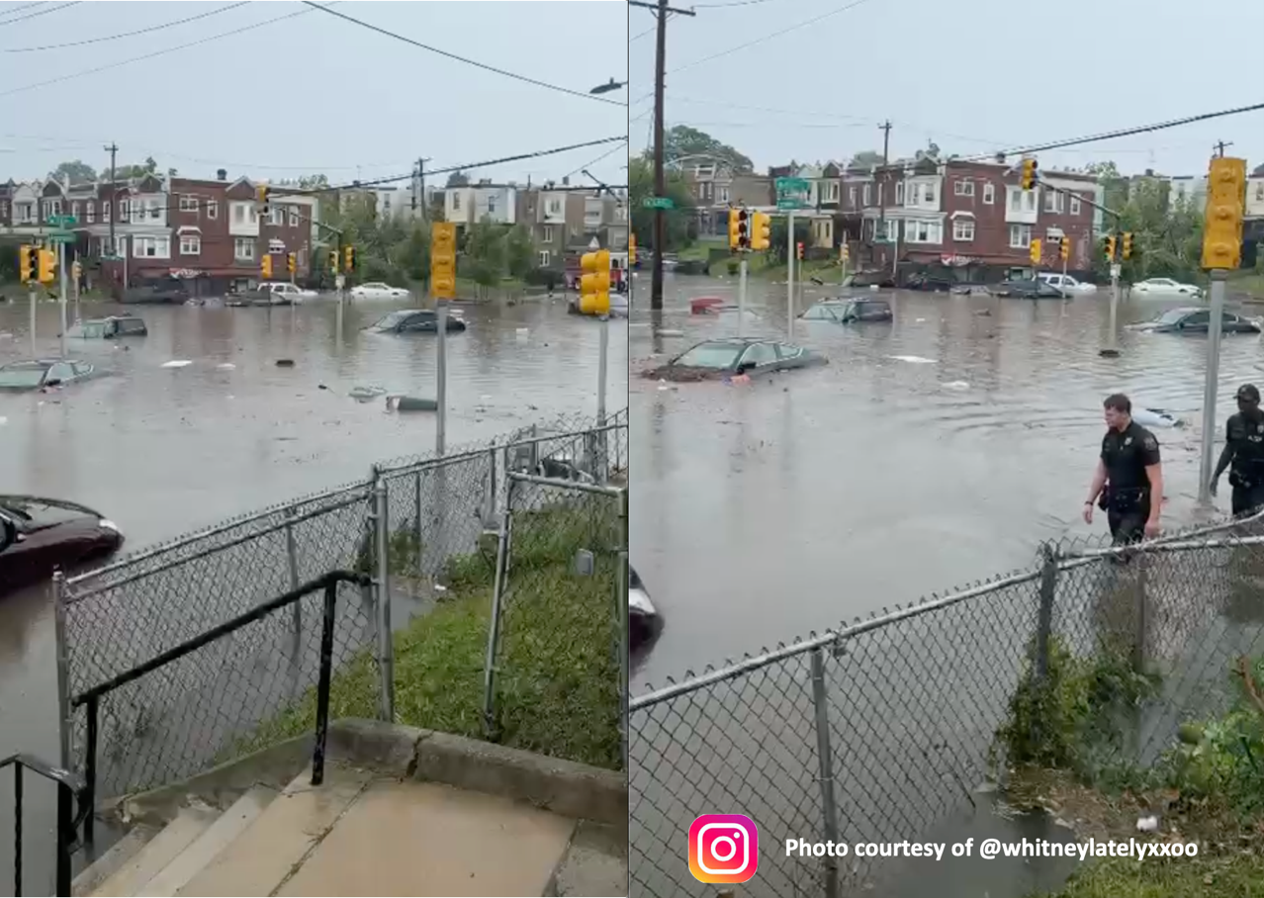 On July 11, nearly one inch of rain fell in just five minutes, flooding one West Philadelphia neighborhood. Photo courtesy of @whitneylatelyxxoo
Philadelphia also faces challenges because it is an older, crowded city. There are already many pipes, wires, and other systems underground. Replacing the city’s drainage system with much larger pipes would be extremely expensive and cause major disruptions to streets and neighborhoods.
There are limits to how much any city can solve extreme flooding simply by building bigger pipes. That’s why PWD uses several different approaches to better prepare Philadelphia for more intense rainfall events.
PWD is using more than one solution
Preparing Philadelphia for heavier rain isn’t just about pipes. PWD uses a mix of approaches to help the city manage stormwater and prepare for a changing climate.
These include:
- Green infrastructure that helps manage stormwater by capturing rainfall where it lands.
- Traditional infrastructure, such as pipes, storage tanks, and other water systems.
- Climate resiliency planning that uses the best available science to ensure the long-term resiliency of Philadelphia’s water systems.
- New ideas and approaches that may help Philadelphia better manage increasingly heavy rain events.
Preparing for tomorrow’s climate: a look ahead
The July 11 storm is a reminder that Philadelphia’s climate is changing and heavy downpours are becoming more common. No city can prevent all flooding, especially during these extremely rare, and intense, storms. But Philadelphia can prepare.
PWD is studying how Philadelphia’s climate is changing and using that information to guide decisions about the city’s water systems. Understanding these changes is the first step toward preparing for them.
The goal is not to eliminate every flood that results from our drainage system becoming overwhelmed. That would be impossible in a densely developed city like Philadelphia, which is filled with streets, sidewalks, buildings, and other hard surfaces that prevent water from soaking directly into the ground. PWD’s goal is to reduce the risks by understanding how climate change will impact our city, and by developing planning, design, and policy strategies to deal with the impacts of extreme storms both now and in the future.