Download summaries of this SMP and its maintenance guidance, with quick reference information for clients and developers:
4.14.1 Blue‑green roof introduction
Blue‑green roofs are a hybrid system consisting of a green roof (moisture-interception layer/geotextile, drainage layer, engineered growing medium, and vegetation above the roofing system and its waterproofing membrane) and a blue roof, a portion of the roof that will become flooded during storm events to aid in the retention of runoff to be used by the green roof vegetation.
Blue‑green roofs provide the combined benefit of the detention and slow-release function of a blue roof with the contaminant removal function of a green roof. The key advantage of the blue‑green roof compared to the green roof is that the maximum tributary area can be potentially increased with the use of an outlet control component designed to meet PWD’s rate of discharge and drain down time requirements.
The design of blue‑green roofs is not limited to the design parameters presented within this text, which focuses on a minimum media depth with a roof drain restrictor system designed to retain water and to meet the maximum Water Quality discharge rates. The designer is referred to Section 4.12 for information on outlet controls.
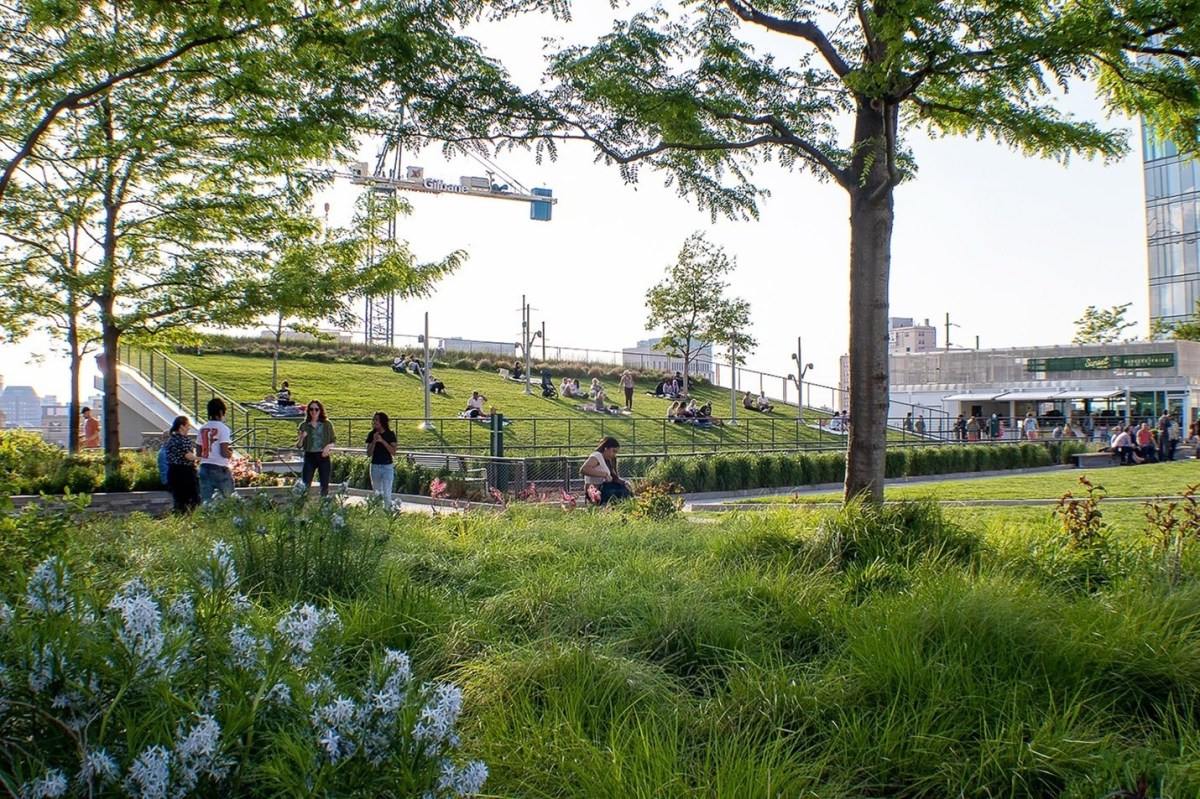
Where can blue‑green roofs be used?
A blue‑green roof can be considered for installation on a fully built-out or highly constrained site. They can be installed on many types of roofs, including terraces, high-rise building roofs, and low-podium or at-grade on-structure installations. Generally, blue‑green roofs are more appropriate for roofs with mild pitches (0–2%), due to structural loading considerations.
Blue‑green roofs can also be installed as a Stormwater Retrofit on existing buildings with flat, mildly sloped, or terraced roofs after confirmation of adequate structural loading capacity, waterproofing, and protection of rooftop utilities.
Key advantages of blue‑green roofs
- Manage stormwater runoff without occupying surface-level space
- Well-suited for sites where roofs make up a large portion of the total impervious area and for sites with ground-level space constraints
- Require no minimum flow path of runoff across the green roof surface since runoff is restricted at the outfall
- Typically require no additional sewer connections besides those already provided for the building
- Promote the retention, slow release, and evapotranspiration of precipitation
- Enhance building aesthetics and market value
- Help regulate building temperature in both the summer and winter, thus reducing cooling and heating costs
- Reduce urban heat island effect by providing evaporative cooling
- Can improve air quality by filtering particulate matter
- Extend the service life of the roof by protecting the underlying roof membrane from mechanical damage, shielding it from UV radiation, and buffering temperature extremes
- Require no excavation
- Can be designed to provide spaces for recreation, supplement bird habitat, develop educational resources, and create new opportunities for urban food production
- Can provide educational benefits, especially when used at public and/or highly visible sites such as schools, recreation centers, libraries, etc.
- Assume less risk for projects within the floodplain
- Eligible for inclusion in an Expedited Post‑Construction Stormwater Management Plan (PCSMP) Review project
Key limitations of blue‑green roofs
- May need to be combined with other SMPs to meet the Flood Control requirement
- More expensive to install than most conventional roofs
- May result in increased cost or limited Stormwater Retrofit opportunities for existing buildings and structures due to additional loading associated with ponded water on roof
- May have limited Stormwater Retrofit feasibility for existing buildings and structures due to structural loading limitations
Key design considerations for blue‑green roofs
- Blue‑green roof systems utilizing controlled flow roof drains generally require flat or nearly flat roofs (e.g., less than 2% slope). It may be feasible to use check dams when slopes are higher than 2%.
- Stormwater management can be improved by introducing measures to enhance evapotranspiration. Measures may include:
- Introducing low-transmissivity drainage layers;
- Lengthening seepage pathways to drains;
- Introducing rainfall interception layers;
- Selecting plants with dense root habits; and
- Selecting growing medium with high water-holding capacity.
- Plant density and coverage are more significant for stormwater performance than specific species type (note that species selections remain important from a habitat and ecosystems perspective). Long-term species selection is flexible provided the plant cover is continuous, the root masses are persistent, and:
- Blue‑green roofs should include a significant percentage of evergreen plants to minimize erosion in winter months.
- For stormwater management purposes, artificial or synthetic turf roofs are not considered green roofs and must be combined with other SMPs.
- For any blue‑green roof that discharges onto an adjacent property, a drainage easement is required.
- Building mechanical systems, roof furniture, and other appurtenances installed on the roof should not be compromised by roof ponding during rain events and must not cause damage to the roof membrane.
- Coordination of blue‑green roof design with the design of building heating, ventilation, and air conditioning (HVAC) systems can help to maximize operational cost savings. For example, some research suggests that green roofs can improve building energy efficiency by lowering the temperature of air at the intakes for climate control systems.
Blue‑green roof types
The blue‑green roof includes a type of green roof combined with a roof drain restrictor system used to retain water in the base of the profile for subsequent plant transpiration, with eventual discharge to the roof drain. The designer is referred to Section 4.3.1 for green roof types.
4.14.2: Blue‑green roof components
Figure 4.14‑1: Partially paved blue‑green roof with typical features
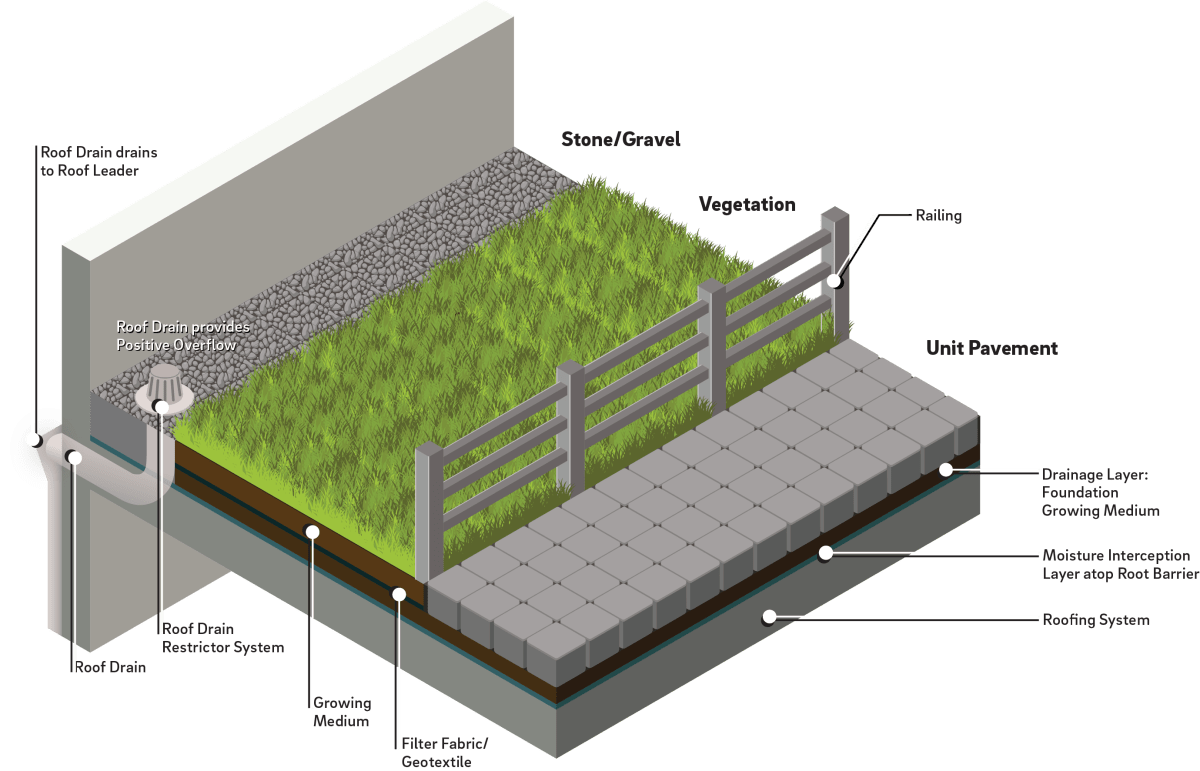
Inlet control component
For blue‑green roofs that receive runoff from roof directly connected impervious area (DCIA), inlet control systems may convey and control the flow of stormwater from the contributing catchment area to the blue‑green roof. Distribution piping may be used to evenly disperse run-on water throughout the blue‑green roof. The designer is referred to Section 4.11, Inlet Controls, for more information on inlet controls.
Storage area component
Blue‑green roof storage areas temporarily hold stormwater before it can either be used by plants through evapotranspiration or be released downstream at a controlled rate. Storage areas for green roofs typically are composed of the following components:
The growing medium supports plant growth and provides for storage of stormwater within voids. The storage capacity is a function of medium depth, surface area, and total void space. The total growing medium depth includes, as applicable, the primary growing medium, root-friendly moisture retention products, and root-friendly drainage aggregates such as foundation growing medium (lightweight drainage aggregate) as a base. Storage in roof drain restrictor systems is determined by the roof slope and geometry relative to both the height of the restrictor and the depth of the growing medium.
Filter fabric, also called separation fabric, or geotextile, prevents migration of soil into the underlying drainage layer of the green roof.
A drainage layer may incorporate measures to intercept and retain percolated rainfall as it moves through the green roof storage area. Examples include synthetic sheets with waffle-type cups to hold water and specialized fabrics or mats with high capillary indices. Drainage products that have low horizontal flow rates and allow deep growth of plant roots are required for green roofs managing runoff from adjacent tributary surfaces. Root-friendly drainage products include foundation growing medium (lightweight drainage aggregates) and waffled reservoir sheets where the cups are filled with lightweight aggregate.
Moisture interception layers are thick geotextiles or other porous materials that retain water and help protect the underlying roof deck. Moisture interception layers can help increase moisture availability to plants between rain events.
Root barriers are impermeable liners or membranes that protect the underlying roof deck from moisture and plant root intrusion. Similar to blue roof storage, blue‑green storage areas are underlain by a waterproofing membrane. Some waterproofing membrane materials are inherently root resistant, whereas others require an additional root barrier.
Numerous waterproofing membrane systems are commonly available, including modified bitumen roofing (MBR), waterproof types of single-ply roofing, metal roof panels, spray polyurethane foam roofing, synthetic rubber membranes, thermoplastic membranes, and liquid-applied (including polyurethane-based and polymer-modified bituminous products) roofing. While high quality MBR systems (multiple MBR sheets tiled to reduce seam susceptibility) are suitable for blue roof usage, lower quality MBR systems (multiple layers of asphaltic sheets) are not recommended due to their seams that allow water to penetrate.
Underlying roofing systems typically consist of a structural deck, its supporting structures, and a traditional overlying waterproofing system. Because of their durability and lack of seams, a hot fluid applied, rubberized asphalt, fabric reinforced roofing system is well-suited for blue‑green roofs. Cold liquid-applied systems are equally effective due to strict regulations on the use of the propane-fired devices for hot fluid systems.
Vegetation component
Blue‑green roof plant material is designed to take up much of the water that falls on the roof during a storm event. Plant cover is instrumental in controlling wind erosion of the underlying blue‑green roof materials. It mitigates soil moisture loss and water erosion, transpires captured moisture back into the atmosphere, and provides evaporative cooling. Plant material also collects dust and creates oxygen. Some blue‑green roofs may also have irrigation systems to support plant growth during dry periods.
Outlet control component
Outlet controls within a blue‑green roof system can provide a range of functions, including the following:
- Meeting drain down time requirements;
- Controlling the rate of discharge from the SMP and limiting water surface elevations during various storm events; and/or
- Bypassing of flows from large storm events.
Outlet controls may include orifices, weirs, roof drain restrictors, risers, scuppers, impervious liners, micro siphon drain belts, and/or low flow devices. The designer is referred to Section 4.12, Outlet Controls, for more information.
Roof drain restrictor blue‑green roofs use a roof drain restrictor that is placed over the roof drain. These devices restrict flow through an outlet control within the drain assembly, causing temporary ponding on the roof. They may be purchased commercially through a manufacturer, or a manufacturer can customize an outlet control sized for a specific development. The number and sizing of weirs and orifices are based on a predetermined relationship between the water depth approaching the drain and the flow rate entering the drain. The overflow mechanism of the device determines the maximum ponding depth.
Micro siphon drain belts are drainage systems that use capillary pressure to wick water out of the soil or filter media and convey it through small siphon channels to collector drainpipes. Their application within a blue‑green roof allows for the collection of stormwater over a large surface area and for meeting very low release rate requirements. Micro siphon drain belts must connect to a downslope collector pipe or roof drain, and they may be installed in the foundation growing medium layer. The designer is referred to Section 4.12.8 for more information on designing micro siphon drain belt systems within a blue‑green roof.
Paving component
Paved walkways, stepping stones, patios, and paver or stone perimeter strips are common elements of blue‑green roof designs. Non-vegetated surfaces that discharge runoff into the vegetated area of the blue‑green roof must count toward the impervious runoff loading ratio.
Inspection and maintenance access component
Safe and easy inspection and maintenance access to all major components within a blue‑green roof is critical to ensuring long-term performance. Dependent on roof height and slope, blue‑green roof inspection and maintenance access components may consist of permanent or temporary safety monitoring systems, guardrail and safety net systems, warning line systems, and/or personal fall arrest systems. Inspection and maintenance access systems for blue‑green roofs may also include long-term leak detection systems for locating and managing leaks.
In the case of accessible roof terraces for residential settings, the provision of a railing with a maintenance gate that separates the vegetated green roof from accessible areas is required. The railing can be metal, wood, or glass. Bird-friendly glass with a Threat Factor Rating of 1–25 is highly recommended. Pet access to green roofs that are certified as SMPs should be restricted, as urine, pet digging, and habitual foot traffic can all damage plants and growing medium, leading to potential erosion and diminished rainfall management performance.
4.14.3 Blue‑green roof design standards
General design standards
- Structural requirements:
- Structural loading must be considered for all blue‑green roof designs, and blue‑green roof design must be coordinated with a licensed structural engineer for both new building construction and retrofits to existing structures.
- A structural engineer must verify that the building will support the weight of the blue‑green roof.
- Design calculations must consider the fully saturated media and flooded storage weight of the blue‑green roof. Due to their water holding capacity, blue‑green roofs typically weigh more than 45 pounds per square foot and are most common in new construction where the roofing design can accommodate these loads.
- Potential maximum loads must be based on American Society of Testing and Materials (ASTM) E2397.
- The entirety of the blue‑green roof footprint must be considered, and modeled as, DCIA. Accordingly, a Natural Resources Conservation Service curve number of 98 must be used for the blue‑green roof, where required for hydrologic calculations.
- Vegetated green roof portions of the blue‑green roof are permitted a DCIA reduction equal to the entire area of the vegetated footprint solely for the predevelopment to post-development impervious area reduction calculation during the determination of potential exemption from the Channel Protection and Flood Control requirements.
- The total impervious roof area within the designated boundary of a blue‑green roof footprint must not exceed the total vegetated green roof area, which is equivalent to a maximum hydraulic impervious runoff loading ratio of 1:1.
- The following are exempt from being counted as tributary impervious area when installed on a blue‑green roof:
- Pervious pavers containing planted openings; and
- Drain chambers, including an adjacent stone margin with an offset distance from the chamber edge of 12 inches or less. All other stone/gravel margins or perimeters must be considered roof DCIA, unless they are graded to allow flow over or through vegetated green roof area, in which case, they may be counted as tributary impervious area to the green roof portion of the blue‑green roof.
- The maximum allowable ponding depth is one inch below the top of the foundation growing medium. For roof drain restrictor systems, this ponding depth maximum can be set at least five feet from the restrictor.
- The maximum allowable drain down time is 72 hours after the 24‑hour storm event.
- Positive overflow must be provided and comply with the Philadelphia Plumbing Code
- The flooded storage area of the blue‑green roof area must be underlain by a waterproofing membrane.
- Root barrier layers must conform to the requirements of the waterproofing provider for each project.
Inlet control design standards
- If runoff is conveyed via piping, a distribution piping manifold must be embedded in a gravel strip to dissipate energy and promote uniform flow. The designer is referred to Section 3.4.2 for information on design standards for distribution piping.
- The designer is referred to Section 4.11 for information on design standards for inlet control systems.
Storage area design standards
- For roof drain restrictor blue‑green roofs that rely solely on growing medium to retain the Water Quality Volume (WQv):
- The minimum allowable thickness of the green roof growing medium for a 1:1 loading ratio is six inches, including two inches of foundation growing medium, which serves as the drainage layer.
- Any contributing impervious surface built atop a blue‑green roof must either allow for sheet flow runoff onto the vegetated portion of the roof, like unit pavement, or be slotted, like decking. The minimum two‑inch thickness of foundation growing medium required for the blue‑green roof must extend under the entire extent of that surface area.
- The top one inch of the foundation growing medium must be maintained above the flooded elevation, starting five feet from the roof drain restrictor, to promote aerated conditions in the growing medium.
- The roof drain restrictor must include an outfall device which limits the WQv discharge flow rate to comply with applicable Water Quality requirements.
- In areas that will receive tributary discharge, the blue‑green roof must not include a high-transmissivity drainage layer, defined as a layer with a transmissivity of greater than 0.005 m2/s (ASTM D4716), where such products limit plant root access to tributary runoff. In general, this will exclude most synthetic sheet drains, including peg-style or egg carton style drains. High-transmissivity drainage layers will allow runoff to effectively flow under the blue‑green roof, minimizing contact with growing medium and plant roots. Typical foundation growing medium (also called granular aggregate or coarse granular green roof medium), with a grain-size distribution complying with ASTM gradation No. 7 will satisfy the requirement, as will also a variety of mats and composite drainage layer assemblies.
- The storage system must provide adequate storage to control release rates to meet all applicable Stormwater Regulations. The designer is referred to Section 3.2.3 for information on using SMPs in series.
- Saturated permeability of the growing medium, in its compacted state [ASTM E2399], must not be less than six inches per hour.
- Filter or separation fabric must allow root penetration but prevent the growing medium from passing through into the drainage layer.
- A drainage layer is required to promote aerated conditions in the growing medium and to convey excess runoff during large rainfall events.
Vegetation design standards
- When fully established, the selected plantings must thoroughly cover the growing medium. Mature plant cover must be a minimum of 80% on established green roofs, with contiguous non-vegetated areas no larger than three square feet (i.e., a 24‑inch diameter circle).
- Plant coverage must persist year-round. While individual plants may exhibit seasonal dormancy, vegetation coverage in winter months must be maintained. Mulch should be limited to 0.25 inches of compost if used as a temporary component in an establishment planting. Mulching can jeopardize green roof performance by clogging the geotextiles within the system and increasing system weights. Mulching also inhibits the reseeding of plants, which is a necessary process for long-term species persistence.
- Plants that are appropriate for, and compatible with, the site conditions must be chosen. The designer is referred to Section 4.13 for additional landscaping guidance and Appendix I for plant lists.
Outlet control design standards
- The contributing drainage area of impervious rooftop to each disconnected discharge point must be equal to, or less than, 500 square feet.
- Roof drain restrictors must be sized according to the desired release rate and ponding depth.
- Internal drainage, including provisions that cover and protect drains or scuppers, must anticipate the need to manage large rainfall events without inundating the cover.
- All drains and scuppers must be covered and protected by an enclosure, typically a square or round chamber with a locking lid. These chambers are designed to prevent clogging of the drains by debris.
- The roof drainage system and the remainder of the site drainage system must safely convey roof runoff to the storm sewer, combined sewer, or receiving water.
- Emergency outflow must be set at an elevation above the height of the roof drain restrictor.
- The designer is referred to Section 4.12 for information on design standards for outlet control systems.
Inspection and maintenance access design standards
- Blue‑green roofs must be designed to allow for safe access and working conditions for green roof inspection and maintenance personnel. This access must be a permanent feature of the building, such as a pilot house, roof hatch, or exterior stairs to the blue‑green roof. Retractable, unsecured ladders should not be required for routine maintenance and inspections due to safety concerns. The design may include other permanent personal safety measures. For blue‑green roofs, designers must specifically assess applicability to Occupational Safety and Health Administration (OSHA) Fall Protection Safety Standards and the American National Standards Institute (ANSI) and American Society of Safety Engineers (ASSE) consensus-based fall protection standards.
- Easy access must be provided to each of the outlet controls, low flow discharge points, and overflow connections to permit removal of debris under saturated conditions.
- Seams, corners, penetrations, mounts, or platforms for mechanical utilities, and any other areas of the roofing membrane where risk of leakage is highest, must be inspected for damage or failure and repaired in a manner consistent with the membrane material.
- For accessible residential roof terraces, a railing with a maintenance gate that separates the vegetated green roof from accessible areas must be provided. The railing can be metal, wood, or glass. Bird-friendly glass with a Threat Factor Rating of 1–25 is highly recommended.
Figure 4.14‑2: Blue‑green roof standard detail
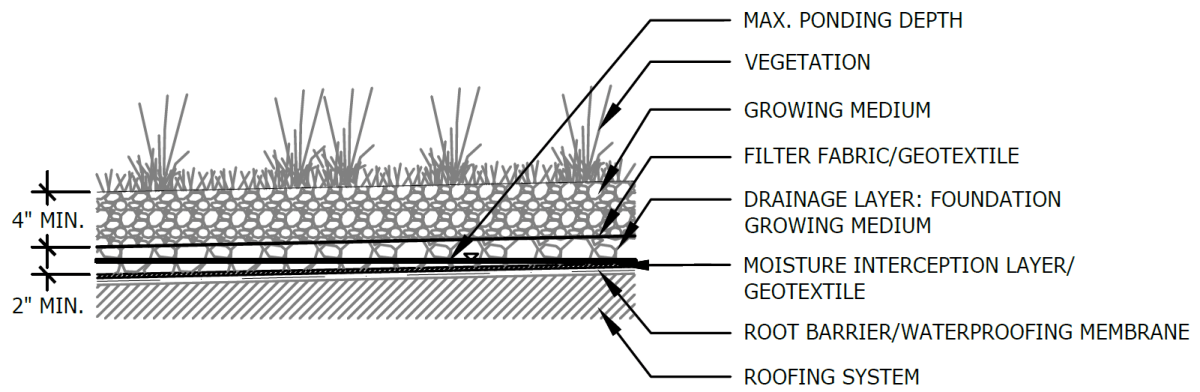
Figure 4.14‑3: Partially paved blue‑green roof with micro siphon drain belt standard detail
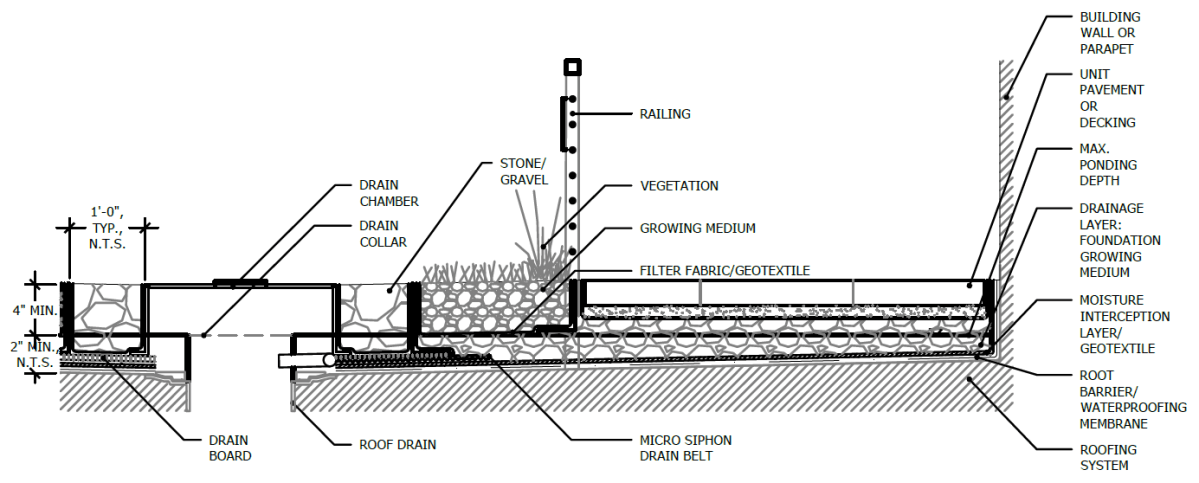
(The designer is referred to Appendix L to download Standard Detail CAD files.)
4.14.4 Blue‑green roof material standards
Inlet control material standards
- The designer is referred to Section 4.11 for information on material standards for inlet control systems.
Storage area material standards
- Green roof growing medium must be a lightweight mineral material with added organic material that meets the following specifications:
- Moisture content at maximum water holding capacity (ASTM E2399 or FLL): 40% to 60% (vol)
- Porosity at maximum water holding capacity (ASTM E2399 or FLL): 10% to 15%
- Density at maximum water holding capacity (ASTM E2399 or FLL): ≤ 85 lbs/ft3
- Total organic matter (MSA): 6% to 10% (dry weight)
- pH (MSA): 6.5 to 7.8
- Soluble salts (DPTA saturated media extraction): ≤ 2 mmhos/cm
- Water permeability (ASTM E2399 or FLL): 0.25 in/min to 1.25 in/min
- Grain-size distribution consisting of ≤ 4.5% passing for clay (0.002 mm) and 5% to 15% passing for silt (0.05 mm). Clay and silt together must not exceed 15%.
- The nutrients must be initially incorporated in the formulation of a suitable mix for the support of the specified plant materials.
- The medium must withstand freeze/thaw cycles.
- Foundation growing medium (lightweight drainage aggregate) must be composed of a blended medium that meets the following specifications:
- Density at maximum water capacity (ASTM E2399‑05): ≤ 65 lbs/ft3
- Maximum water holding capacity: 15% to 25%
- Water permeability (ASTM E2396‑05): ≥ 25 in/min
- Total organic matter by loss on ignition (ASTM F1647): ≤ 1%
- Porosity (ASTM C29): 20% to 65%
- Grain-size distribution (ASTM C136) consisting of the following gradations:
- Pct. Passing US#18 sieve (1.0 mm): ≤ 5%
- Pct. Passing ¼‑inch sieve: ≤ 30%
- Pct. Passing 3/8‑inch sieve (9.5 mm): ≥ 75%
- Pct. Passing ½‑inch sieve (12 mm): 100%
- Geotextile must consist of polypropylene fibers and meet the following specifications:
- Grab Tensile Strength (ASTM-D4632): 70 lbs to 120 lbs
- CBR Puncture Strength (ASTM-D6241): 120 lbs to 340 lbs
- Flow Rate (ASTM-D4491): 130 gal/min/ft2 to 200 gal/min/ft2
- UV Resistance after 500 hrs. (ASTM-D4355): 70%
- Tear Resistance (ASTM-D4533): 30 lbs to 50 lbs
- Heat-set or heat-calendared fabrics are not permitted.
- Root Barrier/Waterproofing Membrane
- PVC, EPDM, and thermal polyolefin (TPO) are permitted and inherently root resistant.
- All waterproof membranes must meet appropriate ASTM specifications. PVC membranes must meet ASTM D4434 requirements, EPDM membranes must meet ASTM D4637 requirements, and TPO membranes must meet ASTM D6878 requirements.
- Waterproofing membrane must be fully waterproof with properly sealed seams, corners, and protrusions to prevent any intrusion of standing water above the membrane.
- Roofing membranes must meet all building code requirements and guidelines of the City of Philadelphia.
Vegetation material standards
- Invasive species are not permitted in green roof planting. All plants must be appropriate and compatible with soil, hydrologic, light, and other site conditions. The designer is referred to Appendix I for plant lists.
- Plant species must be biodiverse. Species diversity for green roofs is defined as follows:
- Sedum: Include at least two genera (i.e., both Sedum and Phedimus) and six different species or cultivars in planting plans.
- Native or adaptive grasses: Provide at least two genera and three different species, if grasses are included in the design.
- Native or adaptive perennials: Provide at least three genera and four different species, if perennials are included in the design.
- Plant establishment:
- Plant establishment may be achieved through plugs, mats, container plants and/or seed.
- The inclusion of seed as a supplement to live plants is required. The designer is referred to Section 4.13.3, Landscape Design Considerations, for a list of species appropriate for overseeding on green roofs.
- Temporary erosion control measures must be provided appropriate to the planting method during the plant establishment period.
- Perennials, grasses, grass-like plants, and groundcover plants must be healthy, well-rooted specimens.
- Green roof plantings must be able to withstand heat, cold, and high winds. After establishment, the plants must be self-sustaining and tolerant of drought conditions, with little to no need for fertilizers or pesticides.
- The only sedum known to be invasive, and which must be avoided is Sedum sarmentosum, also known as star sedum, gold moss, stringy stonecrop, or graveyard moss.
Outlet control material standards
- The designer is referred to Section 4.12 for information on material standards for outlet control systems.
Inspection and maintenance access materials standards
- Personal protection systems must comply with OSHA Fall Protection Safety Standards and the ANSI and ASSE consensus-based fall protection standards.
4.14.5 Blue‑green roof construction guidance
Proper construction of blue‑green roofs is essential to ensure long-term functionality and reduce long-term maintenance needs. Blue‑green roof systems are best installed by experienced roofing contractors with expertise in installing flat roof membranes over new or existing roof structures. A standard construction sequence for proper blue‑green roof system installation is provided below. This can be modified to reflect different blue‑green roof system applications or expected site conditions.
- Inspect waterproof membrane along the roof and parapet wall or any irregularities that will interfere with drainage or may cause leaks. Do not continue until roofer has addressed defects. Confirm height of membrane is at least six inches above the peak ponding elevation as per the SMP designs.
- Confirm all edges, seams, corners, protrusions, and other anomalies are sealed in a watertight manner consistent with the installation specifications of the membrane manufacturer.
- Install root barrier layer, if required.
- Install moisture management layer or geotextile, as appropriate to the design.
- Install drainage layer.
- Install filter fabric, as appropriate to the design.
- Install growing medium, as specified.
- Install irrigation system within the growing medium, if included in design.
- Test the irrigation system, if included in design.
- Install outlet controls in a manner consistent with the City’s Building and Plumbing Codes and guidelines. The designer is referred to Section 4.12 for information on sizing and installation of outlet control systems. Outlet systems must include a bypass/overflow mechanism to permit rapid discharge when the storage volume of the blue‑green roof system is exceeded.
- Finish installing and grading growing medium.
- Install wind protection, if included in the design. A wind scour blanket or hydromulch may be required to prevent erosion during the establishment period. It generally takes about two growing seasons for full establishment. High wind environments may necessitate permanent wind blankets.
- Establish vegetation:
- Blue‑green roof vegetation can be effectively established by broadcasting fresh sedum cuttings during the spring and fall months. Depending on seasonal conditions, irrigation may be required after planting.
- Many perennial plants can be installed as plugs or container plants between April and November. Depending on the time of planting, temporary irrigation may be required.
- Perennials can be established from seed, except during the months of June, July, and August.
4.14.6 Blue‑green roof maintenance guidance
Maintenance of blue‑green roof systems emphasizes maintaining drainage capacity, the health of vegetation, and prevention of clogging via periodic removal of sediment and debris from outlet areas. To maximize the blue‑green roof’s lifespan, inspect all facility components, including vegetation, growing medium, filter fabric, drainage layer, and visible portions of the waterproof membrane.
Regardless of plant density and coverage, control of weed species is encouraged as part of long-term maintenance. The designer is referred to the Landscape Design Guidebook for more detail.
General recommended maintenance activities for blue‑green roof systems are summarized in Table 4.14‑1.
Table 4.14‑1: Blue‑green roof maintenance guidelines
| Early maintenance activity | Frequency |
|---|---|
| Inspect outlet structures, and storage areas for trash and sediment accumulation. | Monthly for the first year after installation to determine ongoing maintenance frequency |
| Water vegetation in the early morning. | Every day for the first two weeks after planting. |
| Every four days for the first year after planting, during periods of four or more days without rain, during June through August. | |
| Hand-weed non-target/invasive plants. | Every three months for the first two years after planting. |
| Inspect vegetation for signs of disease or distress. Treat or replace as necessary. | Every two weeks for the first year after planting. |
| Ongoing maintenance activity | Frequency |
|---|---|
| Remove debris from drainage outlets and outlet screens to prevent clogging. | During inspections or as needed to ensure performance |
| Remove debris from secondary drainage/overflows. | During inspections or as needed to ensure performance |
| Remove excessive buildup of sediment around the outlet controls or within the storage cells. | During inspections or as needed to ensure performance |
| Roof drains must be cleared when soil substrate, vegetation, debris or other materials clog the drain inlet. Under normal operating conditions, all roof discharge must be filtered, and medium must not be vulnerable to migration towards the drains. Sources of sediment and debris must be identified and corrected. | As needed |
| Break up ice formation around outlets and overflows. | As needed during winter months |
| Maintain plant material to provide a minimum of 80% foliage cover during warm months. If coverage rate is declining, determine the reason (e.g., soil nutrition or soil moisture conditions) and implement remedial measures. | As needed (see below) |
| Remove weeds manually and use herbicide only in extreme instances of weed infestations that compromise the plant cover integrity and when herbicides are permitted on a project site (e.g., certain sustainability rating systems do not allow chemical herbicides on site). Remove weeds entirely. | As needed (see below) |
| Thin any overgrown areas of vegetation | As needed |
| Inspect for leaks | During inspections or as needed to ensure performance |
| Inspect root development. If root zone is not well developed, determine the reason (e.g., soil nutrition, soil moisture conditions) and implement remedial measures. | Quarterly |
| Inspect permanent irrigation system and adjust irrigation dosing rates as needed to optimize plant performance and water-use efficiency. | Quarterly |
| Inspect growing medium for evidence of erosion from wind or water. If erosion channels are evident, a problem with the drainage system or with the growing medium is present. Surface ponding or runoff must not occur except during very large rainfall events. Correct the problem, then refresh the affected areas with additional growing medium and provide temporary soil stabilization. | Quarterly |
| In early spring, manually cut dormant herbaceous vegetation from the previous growing season to four to six inches above the ground. | Annually |
| Inspect drain-inlet pipe and containment system. | Annually |
| Test growing medium for soluble nitrogen content. Fertilize as needed. | Annually |
| Maintain records of all inspections and maintenance activity. | Ongoing |
During the plant-establishment period, conduct at least three to four maintenance visits yearly for basic weeding, fertilization, and in-fill planting. Thereafter, conduct at least two annual inspection and light weeding visits (irrigated assemblies will require more frequent maintenance).
Herbicides must be avoided to prevent root penetration of waterproofing.
Apply organic or chemical fertilizer according to soil-testing results to maintain soluble nitrogen (nitrate and ammonium ion) levels between one and four ppm. Mature compost is the best nutrient source for fertilization.
Exercise spill prevention measures from mechanical systems located on roofs when handling substances that can contaminate stormwater.
The designer is referred to Section 4.12, Outlet Controls, and Section 4.13, Landscaping, for information on maintenance guidance for outlet controls and landscaping.